
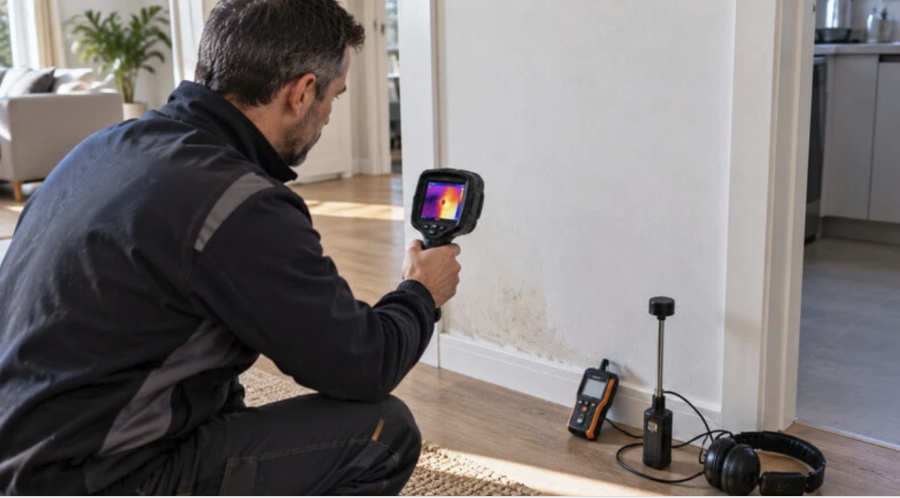
A hidden water leak presents an unusual diagnostic problem. The visible symptom and the actual defect may be separated by a wall, floor, ceiling, service shaft or several layers of building material. Water can also travel away from its source before producing a stain or other visible evidence.
This makes accurate diagnosis important. Knowing that moisture is present is not necessarily the same as confirming a plumbing leak, and confirming that a plumbing system is losing water does not automatically reveal where that loss is occurring.
Modern building diagnostics increasingly address this problem through non-destructive investigation. Instead of opening multiple areas of a building simply to search for a suspected defect, technicians can use complementary diagnostic techniques to gather evidence and narrow down the area requiring attention.
Why Hidden Water Leaks Are Difficult to Identify
Visible plumbing failures are usually straightforward to recognise. Water escaping from an exposed connection, damaged valve or accessible pipe provides an immediate indication of where an investigation should begin.
Hidden leaks are different.
Pipework can run behind wall finishes, beneath floors, above suspended ceilings, through service voids or underground. In commercial and larger residential buildings, plumbing networks can also pass through technical areas that are difficult to access directly.
Even when water eventually becomes visible, its location can be misleading. Moisture may migrate through porous materials, follow joints or move along construction interfaces before appearing elsewhere.
A damp patch should therefore be treated as evidence requiring interpretation rather than automatic confirmation that a pipe is leaking directly behind it.
Condensation, external water ingress, waterproofing failures and drainage problems can sometimes produce symptoms that overlap with those of plumbing leaks. Building diagnostics must consider these alternative explanations.
Why Early Water Leak Detection Matters
An undetected leak can continue consuming water while gradually affecting surrounding materials.
One of the first indications may be an unexplained change in water consumption. Other warning signs can include persistent moisture, changes to paint or finishes, unusual sounds associated with water movement, or recurring dampness in the same area.
Over time, sustained moisture can contribute to deterioration of finishes and some building materials. Depending on the location and construction, prolonged exposure may also create conditions associated with corrosion or microbial growth.
The scale of the consequences depends on factors including the leak rate, duration, location, materials involved and how quickly the problem is identified.
Early detection therefore has two distinct purposes. The first is to establish whether an abnormal water loss or moisture problem exists. The second is to gather enough information to support an appropriately targeted repair.
Those objectives should not be confused with one another.
From Destructive Investigation to Non-Destructive Diagnostics
Before specialised building diagnostic technologies became widely available, investigating concealed leaks could involve exploratory opening of walls or floors.
Physical access is still necessary in some circumstances, particularly when a confirmed defect ultimately needs to be repaired. The difference is that diagnostic work can often provide considerably more information before invasive work begins.
Modern non-destructive water leak detection methods can include thermal, acoustic, moisture, pressure and other investigative techniques selected according to the characteristics of the building and plumbing system. The objective is not to eliminate every invasive intervention, but to make better-informed decisions about where intervention may be required.
This distinction is important. Non-destructive testing should not be interpreted as a guarantee that walls or floors will never need to be opened. Once a fault has been located, physical access may still be necessary for repair.
Its value lies primarily in improving the diagnostic process that precedes that decision.
Main Non-Destructive Water Leak Detection Technologies
No single instrument provides a universal solution for hidden leaks. Different technologies measure different physical effects, and understanding what each technique actually detects is essential.
Thermal Imaging
Thermal imaging cameras measure infrared radiation to represent temperature patterns across surfaces.
In building diagnostics, these patterns can help identify areas whose thermal behaviour differs from surrounding materials. Moisture can influence surface temperature under suitable conditions, making some anomalies visible in a thermal image.
However, a thermal camera does not directly see water inside a wall, nor does it provide an X-ray-style view of concealed plumbing.
A thermal anomaly is therefore evidence to investigate, not automatic proof of a leak. Temperature differences can have other causes, including insulation variations, air movement, heating systems and environmental conditions.
Thermography becomes more useful when its findings are interpreted alongside knowledge of the building and evidence from other diagnostic methods.
Acoustic Leak Detection
Pressurised water escaping through a crack, defective connection or other opening can generate sound and vibration.
Acoustic leak detection equipment is designed to capture and amplify these signals. Technicians can analyse their intensity and characteristics while investigating the suspected section of pipework.
The effectiveness of acoustic diagnosis varies with the circumstances. Pipe material, pressure, leak characteristics, background noise and the surrounding construction can all influence how sound travels and how easily it can be detected.
This makes acoustic equipment particularly useful in suitable pressurised systems, but not automatically appropriate for every concealed water problem.
Acoustic Ground Microphones and Geophones
Geophones and related ground-listening equipment apply acoustic principles to sounds and vibrations transmitted through structures or the ground.
They can be particularly relevant when investigating buried or otherwise inaccessible pressurised pipework. By comparing signals at different positions, a technician may be able to narrow down the area from which leak-related noise is originating.
Environmental conditions matter here as well. Traffic, machinery and other sources of vibration can interfere with interpretation, while pipe material and installation depth affect signal transmission.
For this reason, successful geophone use involves both sensitive equipment and careful interpretation rather than simply listening for the loudest sound.
Tracer Gas
Tracer gas provides a different way to investigate a suspected leak.
In appropriate applications, a suitable gas mixture is introduced into the system being tested. Because the gas can escape through small openings, specialised detectors can then be used to identify where it reaches an accessible surface or surrounding environment.
This approach can be useful when acoustic conditions are difficult or when other techniques have not sufficiently narrowed the search area.
The procedure must nevertheless be appropriate for the particular system. The selection and application of tracer gas is a technical process rather than a general-purpose test that should be performed without understanding the installation.
CCTV Pipe Inspection
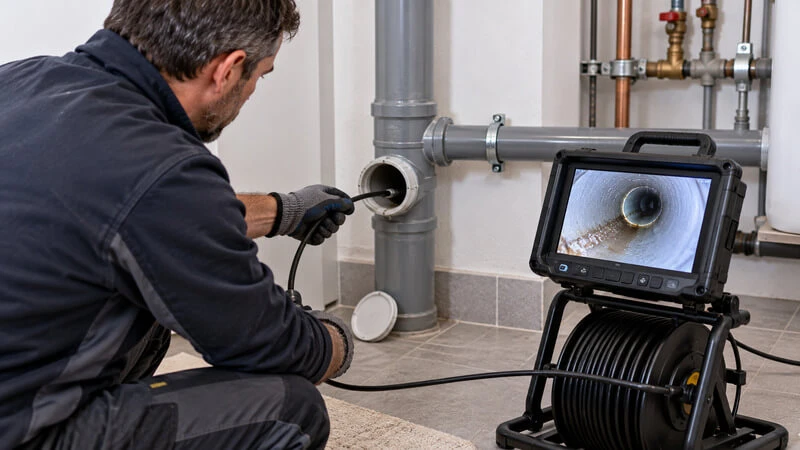
CCTV inspection examines pipe interiors directly where the pipe configuration and access conditions allow a camera to be introduced.
Unlike technologies that infer a problem from temperature, sound or moisture, a pipe inspection camera can provide visual information about the internal condition of an accessible section.
Depending on the system, this can help reveal cracks, breaks, deterioration, displaced connections, obstructions or other visible defects.
CCTV has important limitations, however. It can only show areas the camera can physically reach and see, and it is not applicable to every type of plumbing circuit.
It is especially useful when the suspected problem concerns the internal condition of accessible drainage or pipe infrastructure rather than a concealed pressurised leak that cannot be inspected internally.
Moisture Measurement
Moisture meters and related instruments help assess how moisture is distributed through accessible building materials.
This can be valuable when a visible damp area extends beyond what can be judged by sight alone. Measurements taken at multiple locations can help build a picture of the affected zone and guide further investigation.
Moisture measurement does not necessarily identify the source.
A high reading indicates that a material may be affected by moisture under the conditions of the test, but further investigation may still be required to determine whether that moisture comes from plumbing, external ingress, condensation or another mechanism.
For that reason, moisture mapping often works best as part of a broader diagnostic process.
Pressure Testing
Pressure testing addresses a different question: whether an isolated section of a plumbing system maintains pressure as expected.
A technician can isolate an appropriate circuit, establish controlled test conditions and monitor its behaviour. An unexplained pressure loss may provide evidence that the tested section is not maintaining integrity.
This can be extremely useful for narrowing an investigation.
However, pressure testing illustrates the distinction between confirming a problem and locating it. A test may indicate that a closed section is losing pressure without showing the precise physical point responsible for that loss.
Additional diagnostic methods may therefore be required after the pressure test.
Why Professionals May Combine Multiple Diagnostic Methods
The technologies used for water leak detection are better understood as a diagnostic toolkit than as competing solutions.
A thermal camera provides information about surface temperature patterns. A moisture meter provides information about moisture conditions in materials. Acoustic equipment responds to sound or vibration. Pressure testing evaluates system behaviour. CCTV provides visual information from inside suitable pipes.
These are different forms of evidence.
The appropriate combination depends on the construction, suspected location, pipe material, system pressure, depth, accessibility and symptoms being investigated. TecFuga's technical guide similarly describes method selection as dependent on factors including construction type, leak location, pipe material, installation depth and observed symptoms.
Consider a simplified example. A pressure test might first provide evidence of a loss within a particular circuit. Acoustic investigation could then be used to narrow the suspected location. Moisture measurements might help establish how far surrounding materials have been affected.
In another building, a thermal anomaly may provide the first useful clue, followed by moisture measurements and another technique to test whether the suspected cause is actually plumbing-related.
The sequence is determined by the evidence rather than by a fixed requirement to use every available technology.
Detection, Confirmation and Pinpointing Are Different Tasks
Technical discussions about leak detection sometimes use "detecting" and "locating" interchangeably, but the distinction matters.
A building manager may detect a possible problem after noticing abnormal water consumption. A moisture meter may confirm that a wall contains an unusual moisture pattern. A pressure test may provide evidence that a plumbing circuit is losing pressure.
None of those findings necessarily identifies the exact defect.
Pinpointing the source involves combining the available evidence until the suspected location can be narrowed sufficiently to support a repair decision.
This is also why diagnostic accuracy should not be reduced to simplistic claims about a particular instrument. Equipment produces measurements, images, sounds or observations. Those findings still need to be interpreted in the context of the building.
Water Leak Detection as Preventive Building Maintenance
Leak detection is often associated with responding to an existing emergency, but diagnostic thinking also has a place in preventive building maintenance.
Facility managers and property owners routinely monitor buildings for changes. Water consumption, recurring moisture, unusual pressure behaviour and deterioration of finishes can all provide information about the performance of plumbing and building systems.
When an anomaly appears, investigating it before extensive damage develops can make subsequent repair decisions more targeted.
This does not mean every building requires constant specialised leak testing. Preventive maintenance should be proportionate to the property, its systems, history and observed conditions.
The broader principle is more useful: unusual changes should be investigated rather than repeatedly concealed or repaired at surface level without understanding their cause.
A recurring damp patch, for example, may need more than repainting. Similarly, an unexplained increase in water consumption may justify checking whether consumption patterns or a plumbing fault provide the better explanation.
Water Efficiency and Resource Management
Hidden leaks are also a water-management issue.
Water that escapes unnoticed from a plumbing system provides no useful function but still forms part of the building's consumption. Identifying genuine losses can therefore contribute to reducing avoidable water use.
For commercial properties, residential developments and other managed buildings, this makes leak investigation relevant to both maintenance and resource efficiency.
Monitoring consumption can help identify unusual patterns, but consumption data alone does not diagnose a fault. Higher water use may reflect occupancy, operational changes or other legitimate demand.
The strongest approach combines consumption awareness with physical inspection and appropriate diagnostics when evidence suggests a problem.
Better Diagnostics Support Better Repair Decisions
Non-destructive leak detection has changed the way concealed plumbing problems can be investigated, but its most important benefit is not the sophistication of the equipment.
It is the ability to gather better evidence before deciding where and how to intervene.
Thermal imaging can reveal temperature anomalies. Acoustic equipment and geophones can investigate leak-related sounds. Tracer gas can help trace escape paths in suitable systems. CCTV can reveal internal pipe defects where access permits. Moisture instruments can map affected materials, while pressure testing can provide evidence about the integrity of a plumbing circuit.
Each method answers a different question.
Effective building diagnostics depends on understanding those differences, selecting techniques that fit the situation and interpreting their findings together. In some cases, invasive access will still be required to complete the repair. The objective is not to avoid necessary work, but to avoid unnecessary work.
For property owners, engineers and building managers, that distinction is central to modern leak investigation: diagnose first, establish the likely source with appropriate evidence, and then make a repair decision based on what the building is actually showing.