
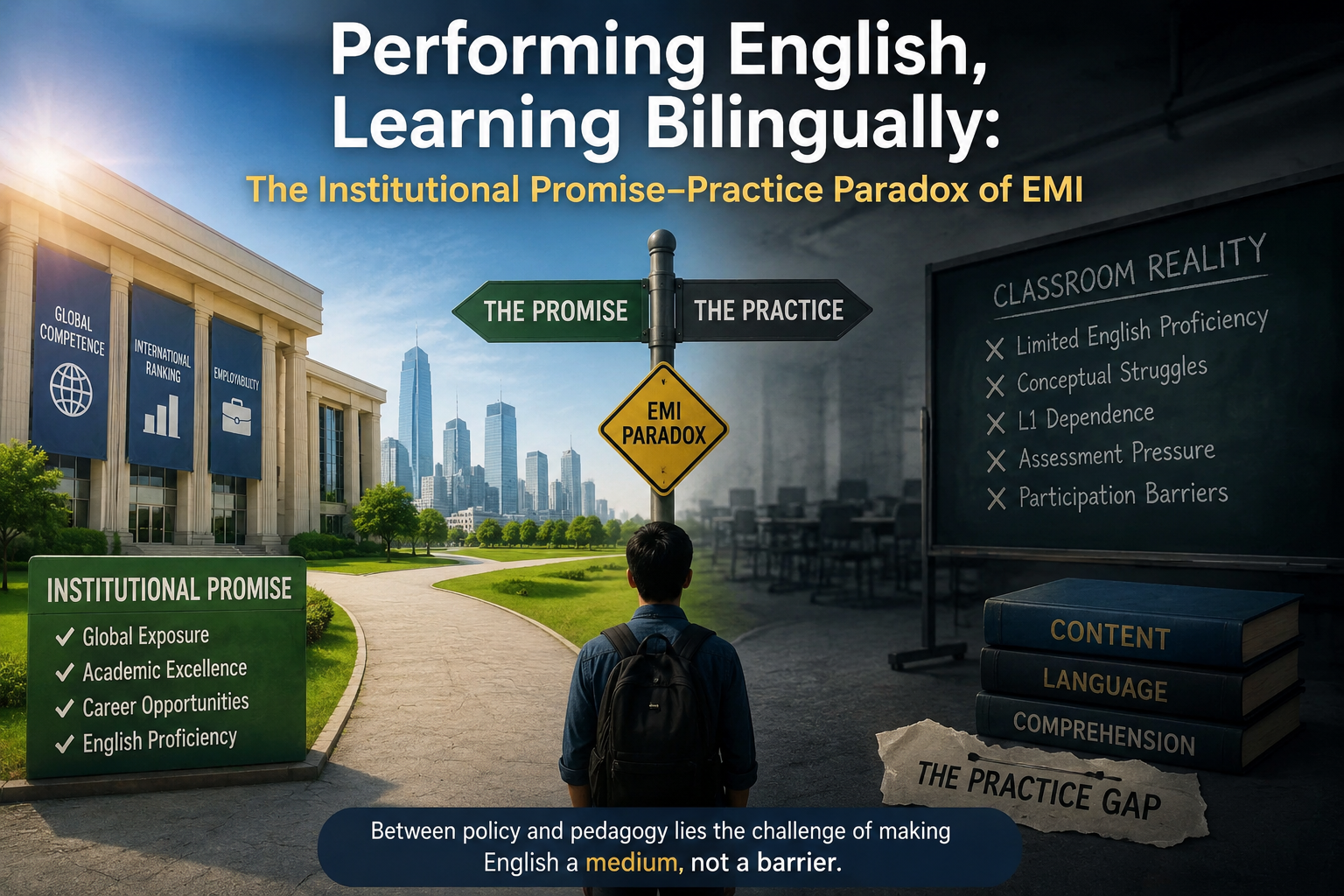
Abstract: English-medium instruction (EMI) has expanded across Bangladeshi higher education as a marker of academic quality, internationalisation, and graduate employability. Yet the institutional promotion of English does not necessarily translate into sustained English-medium classroom interaction or improved opportunities for students’ language development. This qualitative multiple-case study examines how EMI is interpreted, negotiated, and enacted across three private universities in Bangladesh. Data were generated through semi-structured interviews with six teachers of content-oriented English-department courses and 18 final-year undergraduate students, three student focus-group discussions, and three classroom observations. The dataset was analysed using reflexive thematic analysis, supported by iterative coding, memo writing, within-case analysis, and cross-case comparison. Findings indicate that EMI functioned less as a stable English-only instructional model than as a negotiated bilingual practice shaped by uneven English proficiency, time constraints, and institutional expectations. Teachers used Bangla to clarify difficult concepts, sustain interaction, and support comprehension, while students valued English for its academic and professional benefits but often experienced English-only instruction as limiting confidence, participation, and access to disciplinary knowledge. Bilingual mediation, however, rarely formed part of a systematic approach to academic-English development. The central tension therefore lies not simply in teachers’ departure from English-only instruction, but in universities’ expectation that EMI will deliver both disciplinary learning and English proficiency without adequate linguistic, pedagogical, and assessment support. Conceptualising this tension as the EMI institutional promise–practice paradox, the study argues for a linguistically responsive model that combines planned bilingual scaffolding, explicit disciplinary-language development, language-sensitive assessment, and sustained teacher support. By showing how bilingual mediation both sustains and complicates EMI, the study contributes to debates on multilingual pedagogy, linguistic equity, and institutional responsibility in multilingual higher education.
Keywords: English-medium instruction; institutional promise–practice paradox; bilingual pedagogy; higher education; Bangladesh